Got your Lazard assessment link? Try the aptitude test, the workplace behavior questionnaire and a recorded question below in the real format, then read what the 40-minute sitting asks, how the video is scored and how to prepare.
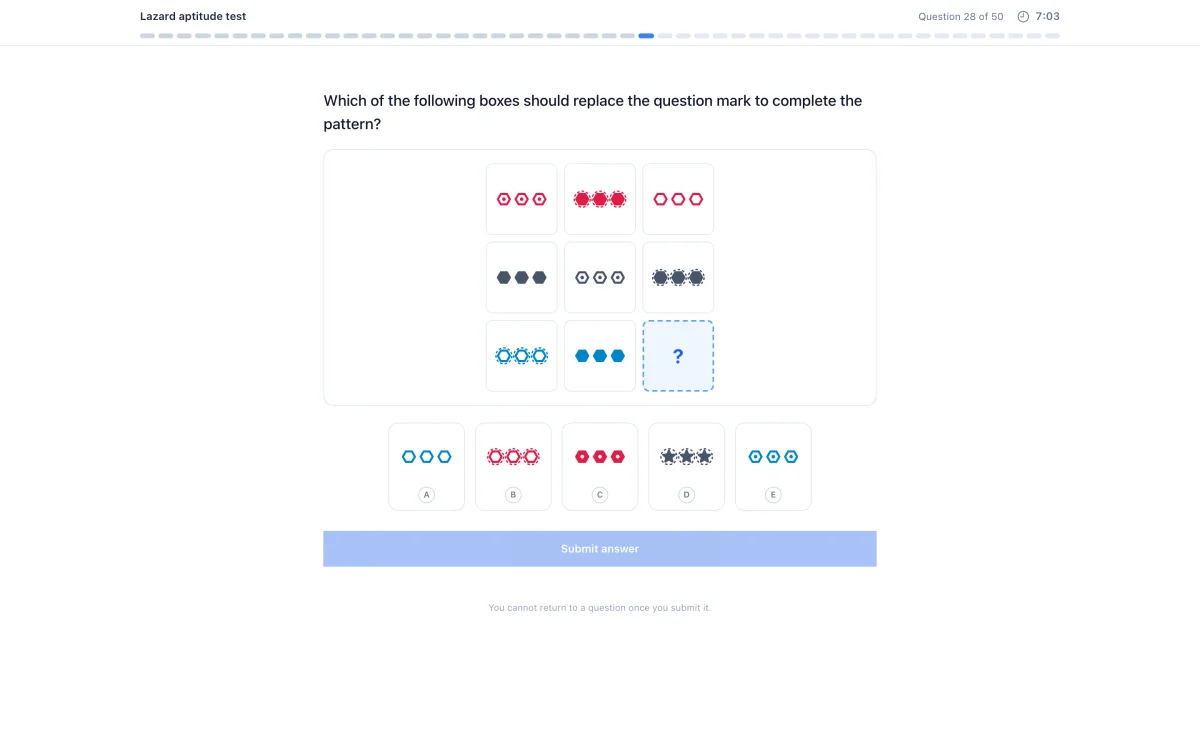
Key facts
- Length: One sitting of about 40 minutes: an aptitude section, a workplace behavior questionnaire, then 3 recorded video questions at the end.2,16
- Aptitude: Short math problems, shape sequences and other logic items, close to Criteria's Cognitive Aptitude Test (CCAT).2,5
- Questionnaire: A workplace behavior questionnaire: statements about how you work, each rated from Strongly Disagree to Strongly Agree, more than 100 of them, some repeated in different words. No right answers.16
- Video: 3 behavioral questions you record on your own, about real situations such as a mistake, a deadline or a team under pressure.2
- Prep time: About 5 seconds to prepare each video answer, so have your stories ready before you start.2
- How the video is scored: An AI tool scores the text transcript of your answers against job-related competencies. It takes no voiceprint or face scan, and a recruiter makes the decision.1
- The tests: The tests come from a third party: standard psychometric tests, such as cognitive, skills and personality assessments, which do not use AI.1
- When: For summer 2028 the 13 US postings went live on Oct 23, 2026, and the first assessment links were out the same day.4,2
- Adjustments: Depending on where you are, you can ask for a reasonable adjustment or an alternative, non-AI format, and ask a person to review the AI output. Lazard says this will not count against you.1
Every US summer 2028 posting links Lazard's notice on these tools. The notice names only a third party; its file name points to Criteria, whose CCAT the aptitude part resembles.3,4,1,2
Try the tests
The aptitude section at the real pace, the workplace behavior questionnaire and a recorded question, on the same screens as the app. Each one opens in its own window, with a report at the end.
Aptitude
Short math, verbal and shape questions against one clock, like the CCAT. You can't go back.
6 questions · 1:48
Workplace behavior
Statements about how you work, strongly disagree to strongly agree. No right answers.
10 statements · untimed, about 1 minute
Recorded video
A Lazard question recorded on your own: a few seconds to think, then your answer, scored.
1 question · 5 seconds to prepare
What the Lazard online assessment looks like
The invite
For summer 2028 Lazard posted 13 US summer analyst roles on Oct 23, 2026, each ending "Apply! We'll get in touch on the next steps." The first assessment links were out the same day the postings went live.3,4,2
Before you start
Criteria's assessments run in a browser with cookies and JavaScript on, and the video needs a webcam and a microphone. Find a plain background in a quiet, well-lit room, silence your phone and read every set of instructions in full: the most common mistake is rushing them. Any deadline is in your invite, and only Lazard, not the test provider, can extend it.7,6,8
The aptitude part
Short math problems, shape sequences and other logic items, much like the CCAT. On the CCAT itself, Criteria sets 50 questions in 15 minutes with no calculator, fewer than 1% of people finish, and there is no penalty for a wrong answer. If Lazard's section runs the same way, guess and move on rather than sit on one item.2,5
The workplace behavior questionnaire
Next comes a questionnaire on how you work. You rate each statement from Strongly Disagree to Strongly Agree, and there are more than 100 of them, some coming back later in different words. Answer as you are, quickly and the same way each time.16
The recorded questions
At the end come 3 behavioral questions, with about 5 seconds to prepare each, so read the question and start talking. In Criteria's one-way interviews the prep and answer limits show at the start of each question, and a practice question can be recorded as many times as you like before the real ones. Use it to check your framing and sound.2,6
How the video is scored
An AI tool reads only the transcript of what you say, plus your name and contact details, and scores it against competencies Lazard has chosen. It takes no voiceprint or face scan. A recruiter reviews the scores beside your resume, application and test results, and makes the decision.1
What comes next
After the sitting comes a screening call, then a first round. In the summer 2027 cycle, San Francisco ran an HR phone screen on your resume and fit, then a very technical first round with two analysts about a week later; Capital Solutions in New York ran a phone screen, then a two-on-one Zoom.12,13
The sitting, part by part
- Aptitude Timed
- Short math, shape sequences and logic, close to the CCAT. No calculator on the CCAT.
- Workplace behavior More than 100 statements
- Statements about how you work, from Strongly Disagree to Strongly Agree. No right answers.
- Practice question Repeatable
- Criteria's one-way interviews open with a practice question you can record as often as you like.
- Recorded video 3 questions
- Behavioral, about 5 seconds to prepare each, scored by AI on the transcript.
- Whole sitting About 40 minutes
- One link: aptitude first, then the questionnaire, the 3 video questions at the end.
The 40 minutes and the 5 seconds come from summer 2028 sittings, and the three parts come in this order, in one sitting. The practice question is how Criteria's one-way interviews work; your invite gives the exact clocks.2,16,6
Before you start the sitting
- An hour blocked off somewhere quiet, since the sitting runs about 40 minutes. Tell anyone you live with.
- Scratch paper and a pencil for the math. Expect no calculator: the CCAT does not allow one.
- A laptop on a steady connection, with Chrome, Firefox, Edge or Safari up to date and other tabs closed.
- Webcam and mic tested, camera at eye level, light in front of you and a plain wall behind.
- Three or four stories ready to tell before you press start: a mistake, a missed deadline, a team under pressure, a time you changed how you explained something.
- Dress as you would for an in-person interview.
- Phone on silent and notifications off.
The sections, one by one
The sitting tests three different things: reasoning at speed in the aptitude part, how you see the way you work in the questionnaire, then how you describe your own past behavior on video. Expect these kinds of question.2,5,16
- Math: Short word and number problems done without a calculator: averages, ratios, percentages.
- Shape sequences: Find the next shape in a pattern, or the figure that does not belong.
- Verbal and logic: Word meanings and short logic puzzles, as on the CCAT.
- Workplace behavior statements: In the questionnaire: how far you agree with statements about how you work. No right answers.
- Communication: On video: an audience that was not following you, and how you changed course.
- Ownership: On video: a missed deadline or work below standard, what caused it and what you changed.
- Teamwork under pressure: On video: a team with competing priorities, and how you helped it deliver.
Here is each part as it appears in Intervyo, in the order of the sitting: the aptitude section as the CCAT draws it, one clock and no going back, the workplace behavior questionnaire, then the recorded questions. Each block says what the part checks and how to answer it well.2,5,16
1.AptitudeLike the CCAT: 50 in 15 minutes
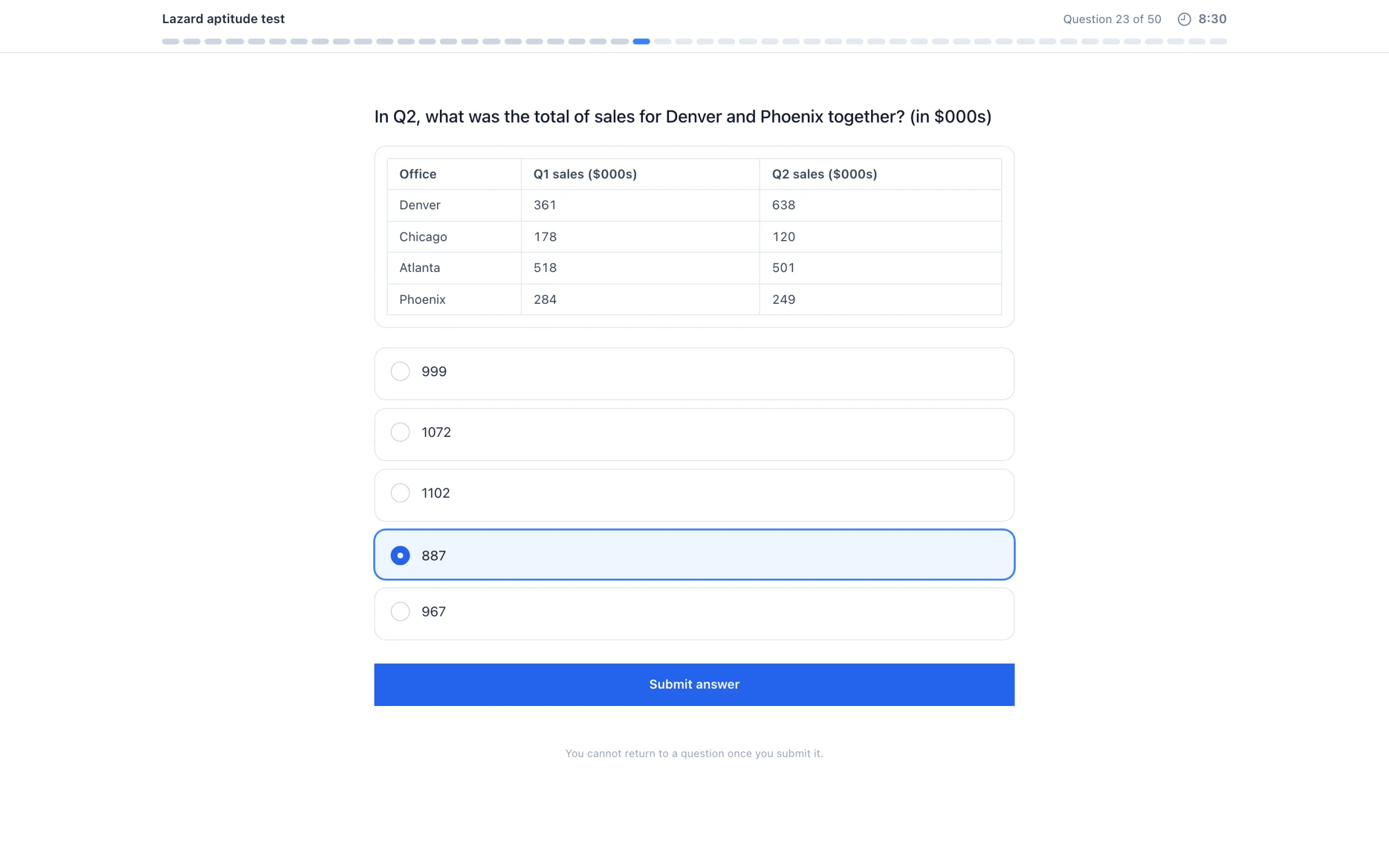
Short math problems, word questions and shape sequences, mixed together against one clock. You submit each answer and can't go back to it. On the CCAT itself that is 50 questions in 15 minutes, about 18 seconds each, and hardly anyone reaches the end.2,5
What it measures: Speed and accuracy on quick reasoning: arithmetic and data, word meaning and analogies, and spotting the rule in a grid of shapes.
How to answer it well
- 1Don't aim to finish. The score is how many you get right, so a careless sprint costs more than the questions you never reach.
- 2Give each question about 20 seconds. If it hasn't clicked by then, pick your best answer and move on.
- 3There is no penalty for a wrong answer, so never leave one blank.
- 4On a shape grid, check each row and each column for what changes: count, shape, shading or turn.
Best guessApplicants compare the section to the CCAT; Lazard and Criteria don't publish its length, so the 50 in 15 minutes is the CCAT's own format.
2.Workplace behaviorMore than 100 statements
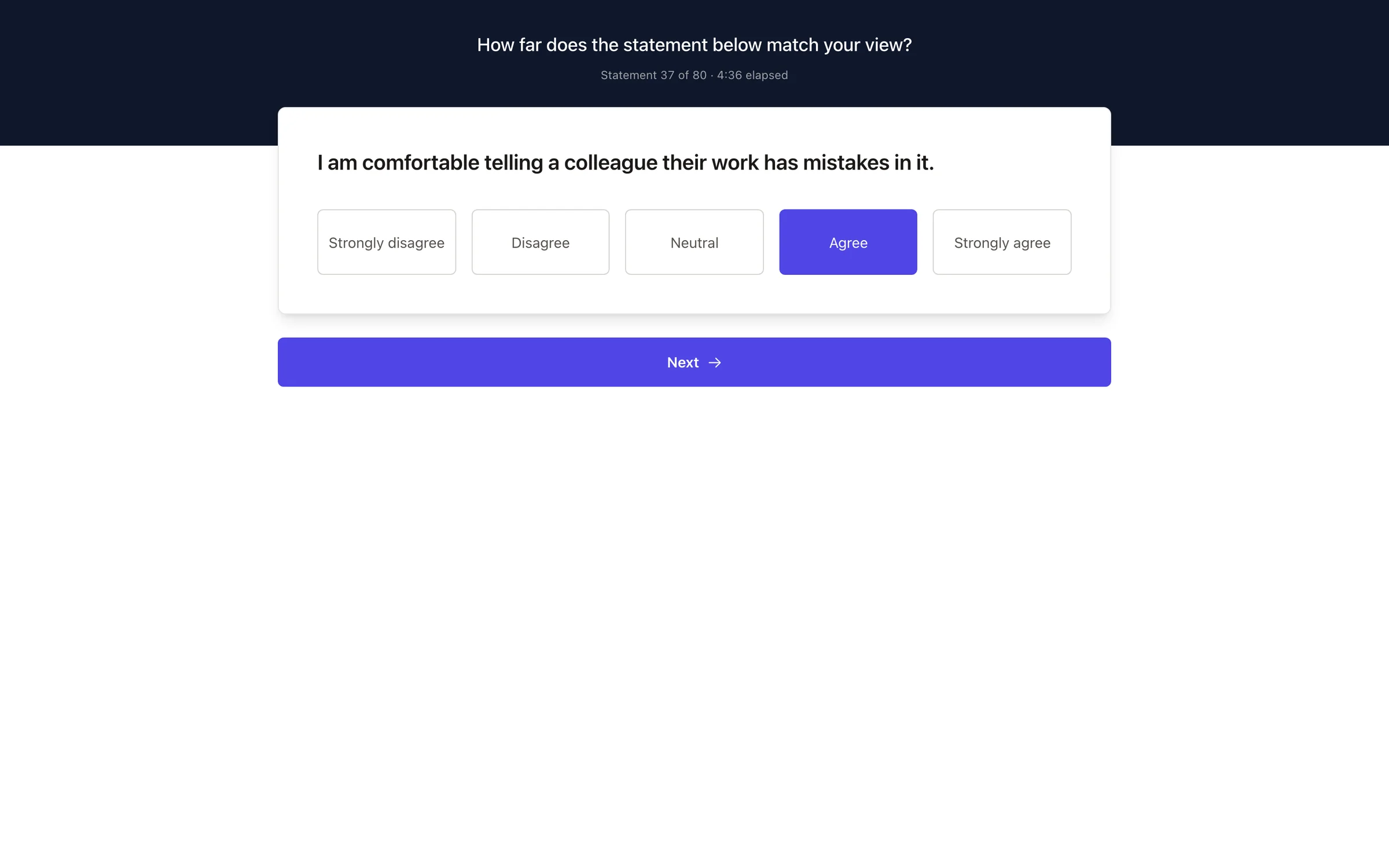
Statements about how you work, each rated on five boxes from Strongly Disagree to Strongly Agree. There is no clock and no right answer, and some statements come back later in different words.16
What it measures: Your behavioral traits and preferences, and how they line up with the role and Lazard's values. Later stages may probe the results.
How to answer it well
- 1Answer as you are at work, and quickly. Second-guessing is what makes answers inconsistent.
- 2Take a side where you have a view. A profile full of Neutral is hard to read.
- 3When a statement sounds familiar, it is probably a repeat in other words: answer it the way you did the first time.
Best guessApplicants report more than 100 statements; Intervyo's full questionnaire is 80.
3.Recorded video3 questions, about 5 seconds to prepare
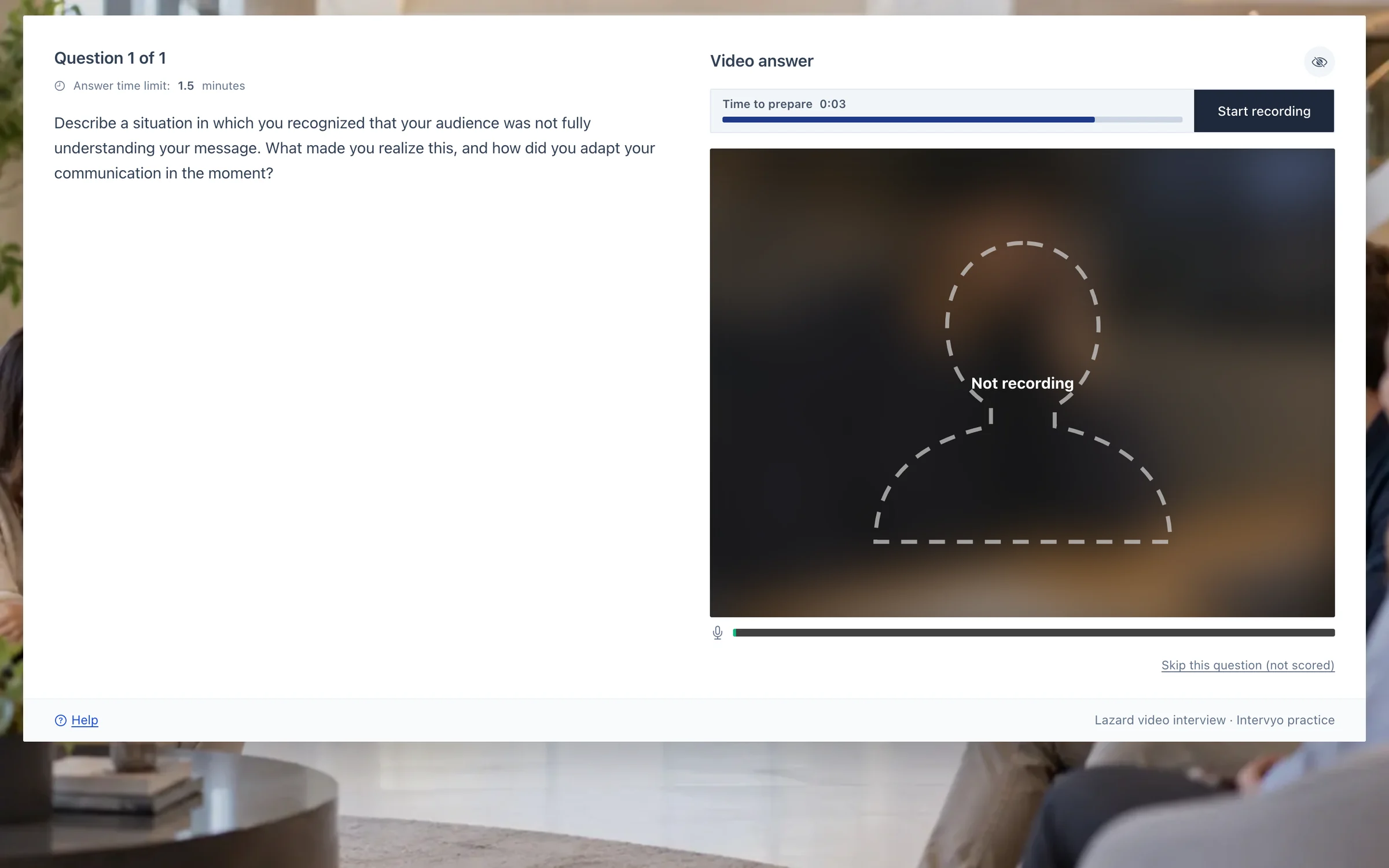
Three behavioral questions at the end of the sitting, recorded on your own with no one on the call. You get only a few seconds to read each question before the recording starts.1,2
What it measures: How you communicate and the competencies in your answer. AI scores the transcript against job-related competencies, and a recruiter makes the decision.
How to answer it well
- 1Prepare three stories before you start: a time you adapted to your audience, a setback and a piece of feedback. Five seconds is not enough to find a story.
- 2Open with the point, then the example, then what changed because of what you did.
- 3Only your words are scored, not your face or voice, so make the structure easy to follow.
Example questions and how to answer them
Aptitude: math"A group of 3 numbers has an average of 17. The first two are 12 and 19. What is the third? (A) 17 (B) 19 (C) 20 (D) 23 (E) 30"5
- 1Turn the average into a total: average times the count.
- 2Take off the numbers you know.
- 3What is left is the answer. Check it against the options and move on.
Tip: This is Criteria's own CCAT sample, not a Lazard item. On the CCAT you have under 20 seconds a question, so do sums like this in your head.
Example answer, written by Intervyo (not a real candidate)
The total is 17 x 3 = 51. Take off 12 and 19, which make 31, and 51 - 31 = 20. The answer is C.
Aptitude: shapes"Five figures each hold three shapes. Four contain a circle, a triangle and a square; one has a circle and two squares. Which does not belong?"5,2
- 1List what every figure shares before you look for the odd one out.
- 2Check one feature at a time: shape type, count, size, position, shading.
- 3The figure that breaks the shared rule is the answer.
- 4If nothing jumps out in 20 seconds, guess and move on.
Tip: Criteria's spatial sample, described in words. Shape sequences came up in the summer 2028 sitting, so practice odd-one-out and next-in-pattern items against a clock.
Example answer, written by Intervyo (not a real candidate)
Every figure has three shapes. Four of them are a circle, a triangle and a square. One swaps the triangle for a second square, so that figure does not belong.
Recorded video: communication"Describe a situation in which you recognized that your audience was not fully understanding your message. What made you realize this, and how did you adapt your communication in the moment?"2
- 1Set the scene in one sentence: who you were explaining what to, and why it mattered.
- 2Name the signal: a question, a blank look, a wrong next step.
- 3Say exactly what you changed: simpler words, an example, a picture, a question back to them.
- 4Close on the result, and what you now do from the start.
Tip: One of the 3 questions in one summer 2028 sitting. With about 5 seconds to prepare, open with the situation sentence you have already practiced.
Example answer, written by Intervyo (not a real candidate)
Written by Intervyo as an example. Last spring I presented our investment club's pitch on a regional bank to about 30 new members. Two minutes in, the first question was what "net interest margin" meant, and I could see others nodding along without following. I stopped the slides and drew it on the whiteboard: the bank borrows from savers at 2%, lends at 6%, and keeps the gap. Then I walked through our thesis again in those terms, and asked someone to explain it back. The questions after that were about the bank, not the words. Now I test any pitch on a friend outside finance first and cut every term they stop me on.
Recorded video: ownership"Tell us about a time you missed a deadline or delivered work that did not meet the expected standard. What contributed to the situation, how did you communicate with the relevant stakeholders, and what did you do differently afterward?"2
- 1Choose a real miss where your own part is clear. Do not pick one that was entirely someone else's fault.
- 2Say what caused it, in two sentences.
- 3Say who you told, when, and what you offered: a new date, a partial version, a fix.
- 4End on the change you made and the next time it worked.
Tip: One of the 3 questions in one summer 2028 sitting; "deadline" and "mistake" came up as themes in other sittings too. The question has three parts, so answer all three in order.
Example answer, written by Intervyo (not a real candidate)
Written by Intervyo as an example. In my research assistant job I was asked to clean a dataset of 2,000 company filings for a professor's paper by Friday. I assumed the formats would match and only checked on Wednesday, when I found a third of them used a different year-end. I emailed the professor that afternoon, explained the problem, sent the two-thirds that were clean, and gave a new date of Tuesday for the rest. I hit Tuesday, but the co-author lost two days of work. Since then I check a sample of every source on day one and flag anything odd before I estimate how long a task will take.
Recorded video: teamwork"Tell us about a project in which your team faced significant pressure or competing priorities that put delivery at risk. What did you do to help the team make progress, how did you prioritize or make tradeoffs, and what was the result?"2
- 1One line on the project, the deadline and why it was at risk.
- 2Your role: what you did, not what "we" did.
- 3The tradeoff: what you chose to drop or delay, and why.
- 4The result in numbers, and what the team kept doing afterward.
Tip: One of the 3 questions in one summer 2028 sitting. The tool scores your transcript, so say the tradeoff out loud in plain words.
Example answer, written by Intervyo (not a real candidate)
Written by Intervyo as an example. Our team of four had ten days to submit a case competition deck while two of us had midterms the same week. By day four we had three half-finished sections and no recommendation. I suggested we agree the answer first and build only the slides that supported it, which meant dropping a market-sizing section two of us had started. I took the financial model, set a check-in every evening, and moved one teammate onto the slides that needed the most work. We submitted a day early, placed third of 22 teams, and the judges singled out how clear the recommendation was. We now write the answer slide first on every project.
More Lazard online assessment questions
Recorded video
“Tell us about a mistake you made.”2
A theme from the summer 2028 sittings, not exact wording
“Tell us about a time you missed a deadline.”2
A theme from the summer 2028 sittings, not exact wording
“Tell us about a time you showed leadership.”2
A theme from the summer 2028 sittings, not exact wording
“Describe a time your audience was not following your message.”2
Summer 2028 sitting; shortened
“Tell us about a team project where competing priorities put delivery at risk.”2
Summer 2028 sitting; shortened
Practice for Lazard with Intervyo
Start free to practice Lazard questions and track when it opens. Go deeper on Lazard with the pack, or cover every firm you apply to with the Season Pass.
Free
Try it and track Lazard
$0no card
Sign up free- An online assessment in the real format
- 2 HireVue-style questions, scored
- A resume review and a cover letter
- The tracker, with alerts for 5 companies
Lazard Pack
Every Lazard stage
$89one payment
Get the pack- 80 online assessment runs and 50 technical questions
- 50 Lazard video interview questions, scored
- 12 live AI mock interviews
- 15 resume reviews and 45 cover letters
- The Lazard process map and 10 research briefs
Premium, $149 adds the superday simulator.
Season Pass
Save 63%Every company you apply to
$16.58a month
Get the Season Pass- 150 online assessment runs a month
- 130 HireVue-style questions a month, every company
- 20 live AI mock interviews a month
- 5 superday simulations a month
- 30 resume reviews and 90 cover letters a month
$199 a year, or $44.99 monthly. Cancel any time.
How long to hear back after the online assessment
There are two waits: from applying to the assessment link, and from the sitting to a screening call. For summer 2028 the first has been days. In the last two cycles, screening calls came within weeks of the postings.2,11,15
Jan 2025 (summer 2026)
Restructuring, New York
First rounds in mid-January, with superday news promised by the end of Jan 17. Offers were out once the superdays finished.15
Mar 2025 (summer 2026)
Private Capital Advisory, New York
Application, then a first-round phone interview on technicals and interest in the group. That process had no recorded video.9
Dec 2025 to Jan 2026 (summer 2027)
Financial Advisory, US
The cycle thread opened on Dec 22, 2025, and screening calls were under way within about two weeks.11
Oct 23, 2026 (summer 2028)
Financial Advisory, US
Postings went live. The same day, one applicant was already facing a 40-minute assessment with 3 recorded questions at the end.4,2
Late Oct 2026 (summer 2028)
Financial Advisory, US
Two replies: the aptitude part is very like the CCAT, with short math and shape sequences, and the video gives about 5 seconds to prepare.2
Around Nov 1, 2026 (summer 2028)
Financial Advisory, US
One more applicant found their sitting mostly similar, and another posted 3 questions from a sitting.2
Your results go straight to Lazard; Criteria cannot give status updates. To check the sitting was submitted, enter your Event ID at Criteria's assessment center.7
Best guessExpect a screening call a few weeks after the sitting, from December 2026 into January 2027, going by the last two cycles. If a month passes with no news, one short email to the US campus team is reasonable.
What happens after the online assessment
Online application
One of 13 US postings on LazardStudentCareers, open from Oct 23, 2026 to Jan 15, 2027.3,4
Online assessment and videoYou are here
This page. An online assessment of about 40 minutes in all: aptitude questions, a workplace behavior questionnaire, then 3 recorded behavioral questions at the end, scored on the transcript.2,16,1
Screening call
A phone screen on your resume and fit: why Lazard, why banking, why the group. Capital Solutions has mixed in technical questions.12,13
First round
Usually two analysts: very technical in San Francisco, a two-on-one Zoom mixing technical and behavioral questions in Capital Solutions.12,13
Superday
Interviews across coverage groups, more behavioral than the first round. Capital Solutions runs four rounds, one of them an LBO case study.14,13
Aptitude section vs recorded video
Both sit behind the same link, with the workplace behavior questionnaire between them, but they test different things. The aptitude part is about speed and accuracy; the video is about what you say.
What it is
3 behavioral questions, recorded on your own.2
Timing
Part of a sitting of about 40 minutes. The CCAT itself is 50 questions in 15 minutes.2,5
About 5 seconds to prepare each answer.2
How it is read
On the CCAT, the employer gets your raw score and your percentile.5
AI scores the transcript against job-related competencies; a recruiter decides.1
FAQ
Does Lazard have an online assessment for summer 2028?
Yes. Every US summer 2028 posting links Lazard's notice on its third-party tests and AI video tool, and the sitting runs about 40 minutes: an aptitude section, a workplace behavior questionnaire, then 3 recorded questions.3,4,1,2,16
Is the Lazard assessment a HireVue?
Applicants call the video part a HireVue, but Lazard's notice describes a third party's AI-enabled video interview tool, and the notice's file name points to Criteria. Treat it as a one-way recorded interview either way.2,1
What is on the Lazard aptitude test?
Short math problems, shape sequences and other logic items, much like Criteria's CCAT. The CCAT itself mixes verbal, math and logic, and spatial questions, with no calculator, so practice all three against a clock.2,5
What is the Lazard workplace behavior questionnaire?
A personality questionnaire in the same sitting, between the aptitude test and the video. You rate statements about how you work from Strongly Disagree to Strongly Agree. It has no right answers, and some statements repeat in different words, so answer consistently.16,1
How long do you get to prepare each Lazard video answer?
About 5 seconds, so be ready before you press start. Criteria shows each question's prep and answer limits at its start, and you can repeat a practice question as often as you like first.2,6
How is the Lazard video scored?
An AI tool scores the text transcript of your answers against job-related competencies Lazard has chosen. It does not use a voiceprint or a face scan. A recruiter reviews the scores with your resume, application and test results, and makes the decision.1
Are the video questions the same for everyone?
Treat them as possibly rotating. The summer 2028 sittings share the same themes, mistakes, deadlines and teamwork, and Criteria says everyone applying for the same job gets the same set. The 3 questions on this page are the best guide there is.2,6
Can I ask for a different format?
Yes. Depending on where you are, you can ask for a reasonable adjustment or an alternative, non-AI format, and ask a person to review the AI output. Lazard says this will not count against you. The US contact is FA.campus.recruiting@lazard.com.1
Online assessment at other firms
Sources
Firm pages first, then dated candidate reports. Last checked Nov 4, 2026.
- 1Lazard: Global Notice on the Use of AI-Enabled Interview Tools in Recruitment
- 2Candidate report on a public forum: Lazard hirevue (Oct 2026)
- 3Lazard (LazardStudentCareers): 2028 Summer Analyst, New York M&A / Restructuring Generalist
- 4Lazard (LazardStudentCareers): Lazard Student Careers, job listings
- 5Criteria Corp: What to Expect on the Criteria Cognitive Aptitude Test (CCAT) · prep site
- 6Criteria Corp: About Video Interviewing · prep site
- 7Criteria Corp: Candidate FAQs · prep site
- 8Criteria Corp: How Job Candidates Can Prepare For Employment Tests · prep site
- 9Candidate report on a public forum: Private Capital Advisory Summer Analyst interview, New York (Mar 2025)
- 10Aced: Lazard Investment Banking Summer Analyst Interview Guide · prep site
- 11Candidate discussion on a public forum: Lazard 2027 Summer Analyst Program (Dec 2025 to Feb 2026)
- 12Candidate report on a public forum: 2027 Summer Analyst interview, Investment Banking, San Francisco (Jan 2026)
- 13Candidate report on a public forum: Summer Analyst interview, Structured Capital Solutions, New York (Feb 2026)
- 14Candidate report on a public forum: Intern interview, New York (Feb 2026)
- 15Candidate discussion on a public forum: Lazard SA 2026 Megathread (Jan 2025)
- 16AptitudePrep: Lazard Online Assessment (Feb 2026) · prep site
Intervyo isn't affiliated with, endorsed by or sponsored by Lazard. Formats change between cycles and divisions, so always follow the instructions in your own invite.