Blog
Students: Get interview ready in 7-14 days with AI mock interviews
26 August 2026
An AI mock interview is a simulated interview conducted by software that generates role-specific questions and scores your responses against a rubric, in real time. The benefit over generic preparation is direct: candidates rehearse the actual format they will face, whether a HireVue screen or a technical round, and receive scorecards within minutes rather than waiting on a friend’s schedule. Platforms such as Intervyo build this into a structured system, pairing firm-specific question banks with detailed performance reports.
TL;DR:
- AI mock interviews are most effective when tailored to specific roles and formats, with practice sessions focusing on the relevant question types and pacing.
- Voice-based practice accelerates behavioral skill refinement by exposing actual delivery issues, while typed responses are better suited for technical accuracy.
- Consistent review of transcript analytics and scorecards over a two-week cycle helps identify pattern improvements and targeted skill gaps.
- Combining AI practice with human feedback bridges nuance and cultural fit evaluation that AI cannot fully replicate.
- Use role-specific, rubric-based AI platforms that offer multiple formats to maximize realistic preparation within a structured timeline.
Table of Contents
- How does an AI mock interview actually work?
- Which interview format should you practise, and when?
- What does instant AI feedback actually include?
- How should you structure your AI interview practice?
- How Intervyo puts these features into practice
- What questions might AI generate for different roles?
- Are AI mock interviews better than practising with a person?
- What platforms exist for AI mock interview practice?
- How do AI mock interviews fit into a wider prep strategy?
- Start practising with Intervyo’s AI interview tools
- A note on using AI mock interviews responsibly
- Sources
How does an AI mock interview actually work?
Every credible AI mock interview follows the same operational sequence, regardless of the platform behind it. Understanding this flow matters because it tells you what to prepare before your first session and what to expect once it starts.
- Input parsing. You upload a CV or paste a job description. The system extracts the target role, seniority level, and key skills, then cross-references them against a question bank. Many dedicated tools generate questions from a pasted job description or uploaded CV specifically to keep practice relevant to the actual role rather than generic interview clichés.
- Question generation and mode selection. The AI selects a practice mode: voice-based conversation, typed responses, a timed round, or a full simulation covering several stages back to back.
- Delivery and adaptive follow-up. The interviewer asks a question, listens or reads your answer, and often probes further, exactly as a human interviewer would push on a vague claim.
- Feedback generation. Within moments, you receive a transcript, a scorecard, and usually a rewritten model answer.
The AI builds its rubrics from a mix of role taxonomies and, on more advanced platforms, transcripts of real interviews at target firms. That is why the questions on a finance-focused tool differ noticeably from those on a general careers site.
What you get back typically includes:
- A full transcript of your answers, timestamped
- A scorecard breaking performance into distinct categories
- A rewritten or “model” version of your weakest answer
- Notes on pacing, filler words, and structural gaps
This loop, generate, practise, review, is what separates a mock interview with AI from simply talking to a chatbot.
Which interview format should you practise, and when?
Not every round calls for the same practice setup. Matching the format to the right mode of AI interview practice is where most candidates waste time, either over-rehearsing one round type or under-preparing for another entirely.
- Behavioural rounds reward STAR-based prompts (Situation, Task, Action, Result). Voice mode suits these best because it forces you to structure an answer aloud under mild time pressure, the same pressure you’ll feel across the table.
- Technical rounds need a platform with code editor support, test cases, and the ability to push back on an incomplete solution, similar to how a real interviewer probes edge cases.
- System design and product rounds run at a slower, conversational pace. Good simulators mimic a whiteboard exchange, asking clarifying questions rather than firing rapid prompts.
- Recruiter screens and coffee chats are shorter and less formal. These sims focus on motivation, fit, and “why this firm” questions rather than technical depth.
AI mock-interview tools commonly offer distinct round types (https://coril.ai/), recruiter screen, hiring manager, skills assessment, and final round, each with its own persona and pacing. That distinction is worth checking before you book a session: a tool that only simulates one round type will leave you underprepared for the others.
Voice practice tends to accelerate behavioural answer refinement faster than typing, because it exposes your actual delivery: hesitations, run-on sentences, weak openings. Typed practice still has its place for technical rounds where precision of wording matters more than delivery.
What does instant AI feedback actually include?
Feedback is only useful if you know how to read it. Most platforms score answers across four recurring axes: structure, relevance, communication, and factual correctness. Some services generate a multi-axis scorecard benchmarked against real interview transcripts, which gives the score more weight than a generic “good job” rating.
Alongside the scorecard, expect:
- A STAR rewrite of your weakest answer, showing exactly where the structure broke down
- A model answer for comparison, not to memorise, but to see the gap between your phrasing and a tighter one
- Transcript analytics flagging filler words, pacing issues, and any claims you made that weren’t backed by specifics
- A trend report across sessions, showing whether your structure score is actually improving or plateauing
Voice-based practice with an immediate transcript and score tends to accelerate refinement because you can see, word for word, where an answer drifted.
Pro Tip: Don’t just read your score. Read the transcript line by line and mark the exact sentence where your answer lost focus. That single sentence is usually the fix, not the whole response.
The mistake most candidates make is treating the score as the endpoint. It’s the diagnostic. If your “structure” score stays flat across three sessions while “communication” climbs, that’s a signal to drill STAR framing specifically, not just to keep practising broadly.
How should you structure your AI interview practice?
A scattershot approach to interview prep, one session here, one there, rarely moves the needle. What works is a short, deliberate schedule in the final one to two weeks before your interview.
- Refine your inputs first. Paste your actual CV and the specific job description, not a generic template. Tailoring questions from the real job description reduces irrelevant practice and more closely predicts what you’ll actually be asked. Intervyo’s career advice resources are useful here if you’re unsure how to phrase a CV bullet for maximum relevance.
- Run a 7 to 14 day cycle. Early days: short 15 minute warm-ups covering easy behavioural prompts. Mid-cycle: focused 30 minute drills on your weakest round type. Final days: full 45 minute simulations covering the entire loop, recruiter screen through final round.
- Repeat by round type, not just overall. Aim for five to ten sessions per round type. One technical mock won’t reveal a pattern; five will.
- Use scorecards to set daily micro-goals. If Monday’s session flags weak pacing, Tuesday’s goal is simply to slow down, not to fix everything at once.
Pro Tip: Book your first full simulation early in the cycle, even if it goes badly. A rough baseline session tells you exactly which round type needs the most reps, so you don’t waste the final week guessing.
On privacy, be sensible about what you paste into any AI mock interview practice tool. Avoid uploading a CV with sensitive personal identifiers beyond what’s necessary, and check a platform’s data retention settings before assuming your transcripts are deleted automatically. A mixed plan of short daily drills plus full simulations is what learning platforms consistently recommend for measurable improvement in confidence and structure.
How Intervyo puts these features into practice
Everything covered so far, tailored questions, varied formats, instant scoring, maps directly onto a working platform rather than staying theoretical. Intervyo’s suite of tools is built around that exact loop, with each feature answering a specific gap identified above.
- Live AI interviews with Vyo handle the voice-based, adaptive-follow-up practice described earlier, producing a transcript and scorecard after every session through the live AI interview feature.
- Free HireVue practice covers the timed, video-recorded format many finance and consulting applicants face early in a process, with AI-scored feedback on delivery and content.
- Coffee chat simulations replicate the informal, motivation-focused conversations that recruiter screens and networking calls demand.
- Assessment centre simulation extends single-interviewer practice into a full panel setting, useful for the multi-stage loops common in graduate schemes.
- Analytics dashboards track scorecard trends across sessions, turning the “trend report” concept into something you can actually check week over week.
… Together, these tools cover the full range of formats discussed above, question generation, mode selection, scoring, and review, inside one platform rather than several disconnected apps.
What questions might AI generate for different roles?
The value of AI interview coaching shows most clearly in how specific the questions get once a role is defined. A generic “tell me about a challenge you faced” prompt tells you little; a well-tuned system narrows that down fast.
For an investment banking analyst track, expect technical drills on discounted cash flow assumptions, questions on recent market-moving deals, and behavioural prompts framed around working under tight deadlines with senior stakeholders watching.
A management consulting case round typically generates a market-sizing or profitability problem, followed by structured probing on your assumptions, plus a “walk me through a time you disagreed with a team lead” behavioural prompt.
Law firm interview simulations lean on scenario-based ethics questions, a discussion of a relevant practice area, and motivation questions about why that specific firm over its close competitors.
Software engineering rounds generate live coding problems with test cases, followed by system design prompts that scale in complexity as you answer, and a behavioural segment on handling a production incident.
Product management simulations often centre on a feature prioritisation scenario, a metrics-definition question, and a stakeholder-conflict behavioural prompt. The pattern across all of these: the AI adjusts difficulty and follow-up questions based on how confidently you answer the first probe, which is closer to how a real panel operates than a static question list.
Are AI mock interviews better than practising with a person?
Neither format replaces the other, and treating this as a straight substitution misses the point. Each has a distinct strength.

AI interview practice wins on availability and volume. You can run a session at midnight, repeat a weak round type five times in an evening, and get a scorecard in seconds rather than waiting for a friend’s free evening. It’s also consistent: the same rubric applies every time, so your improvement across sessions is genuinely comparable.
Where AI still falls short is nuance and rapport. A human interviewer, particularly someone who’s actually worked at your target firm, picks up on subtleties an algorithm doesn’t: whether an answer sounds rehearsed, whether your energy matches the firm’s culture, or whether a technical explanation would actually land with a specific interviewer’s background. Human mock interviews also allow for the kind of tangential, off-script conversation that sometimes appears in real Superdays and can catch unprepared candidates off guard.
The practical answer is sequencing: use AI mock interview tools for volume and repetition early in your preparation, then bring a human, a mentor, a career services advisor, or a peer, into the final rounds to stress-test rapport and catch anything the AI’s rubric can’t see. Repeated rehearsal across formats correlates with higher reported confidence among candidates who use it, which supports treating AI practice as the volume layer rather than the final check.
What platforms exist for AI mock interview practice?
The market has split into two distinct categories, and knowing the difference saves you from wasted sessions. General-purpose AI chatbots can simulate a rough interview conversation if you prompt them carefully, but they lack scoring rubrics, transcript analytics, or role-specific question banks built from real hiring data. A comparison of AI tools for job interviews makes this distinction clear: general chatbots handle open-ended conversation, but dedicated systems handle structured evaluation.
Dedicated AI mock-interview simulator platforms sit in the second category. Some focus on broad job-profile coverage, generating practice across a wide span of industries and roles. Others specialise in voice-based delivery with transcript scoring built specifically around benchmarked rubrics. Still others focus tightly on one competitive vertical, tailoring question banks to specific firms and interview formats within that sector, which is where Intervyo positions itself for finance, consulting, and law candidates.
The practical filter when choosing among ai mock interview tools: does the platform tailor questions to your actual target role, does it produce a rubric-based scorecard rather than vague praise, and does it offer more than one practice mode. A tool that only does typed Q&A with no voice option, for instance, won’t prepare you for a timed video screen.
How do AI mock interviews fit into a wider prep strategy?
AI mock interviews work best as one layer in a broader system, not a standalone fix applied the week before an interview. The strongest candidates treat preparation as four connected layers: research, technical or case skill-building, mock practice, and review.

Research covers firm-specific knowledge, recent deals, cases, or product launches that a technical answer alone won’t demonstrate. Skill-building is the underlying competence, financial modelling, casing frameworks, or coding fluency, that no amount of mock interviewing substitutes for. AI mock interview practice then becomes the rehearsal layer, where you test whether that underlying skill translates into a clear, structured answer under time pressure. Review closes the loop: reading transcripts, tracking scorecard trends, and adjusting the next session’s focus accordingly.
Sequencing matters. Doing mock interviews before you’ve built the underlying technical skill wastes sessions on content gaps the AI can’t fix for you. Doing them only in the final 48 hours leaves no time to act on the feedback. The candidates who improve fastest tend to start structured mock practice two to three weeks out, reviewing scorecards after each session and adjusting the next one’s target, rather than running the same generic session repeatedly and hoping repetition alone closes the gap.
Start practising with Intervyo’s AI interview tools
If you’ve read this far, you already know the gap between rehearsing generically and rehearsing against the exact round you’re about to face. Intervyo closes that gap by building its question banks from real firm-specific interview data, so the practice you do matches the interview you’ll actually sit.
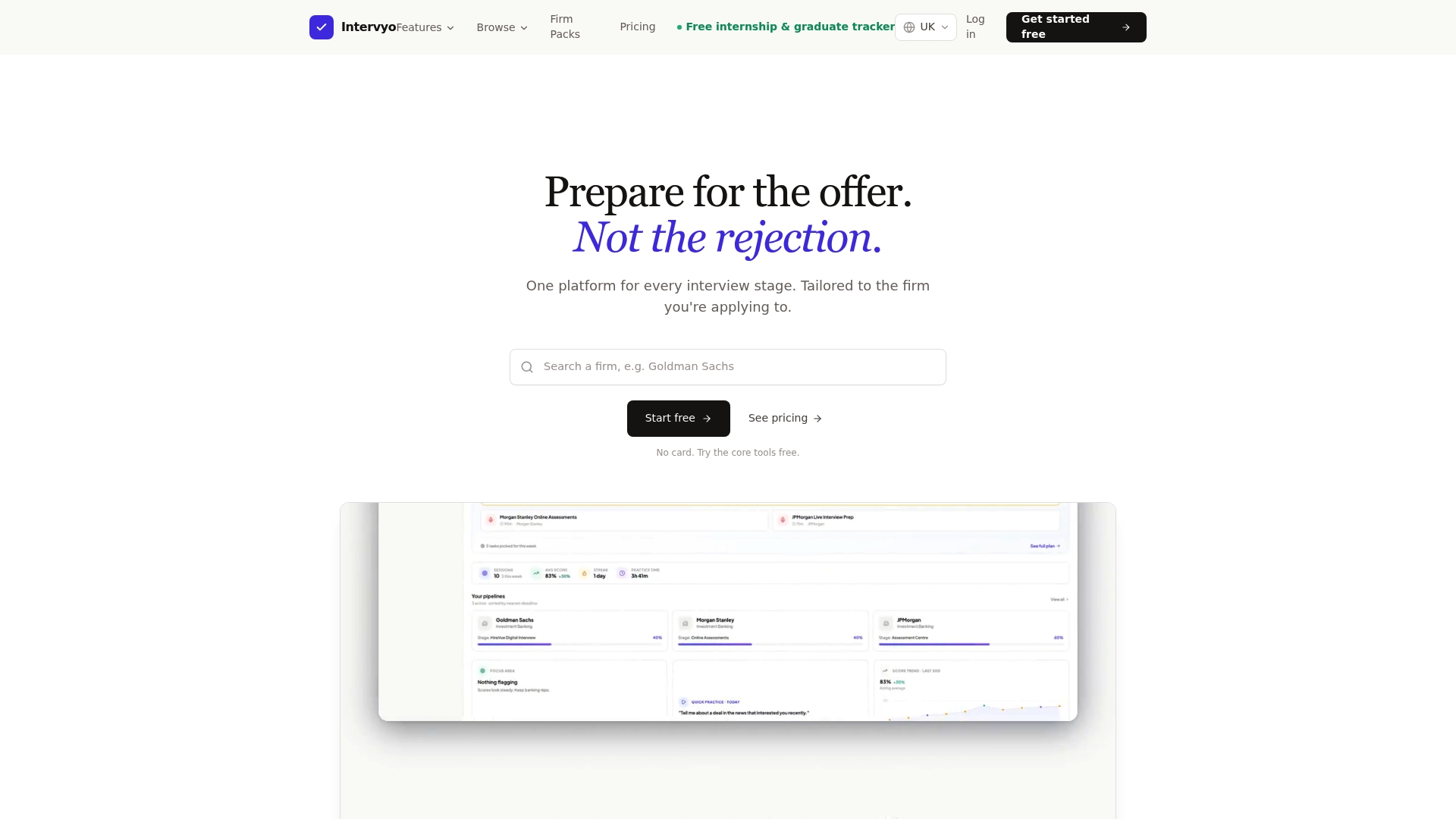
Start with whichever format matches your nearest deadline. If a video screen is coming up, run a session on free HireVue practice to get scored feedback on delivery and content before the real thing. If you’re facing a live panel or first-round call, Vyo gives you a full voice-based simulation with a transcript and scorecard at the end. Preparing for a networking call or informal screen first, try the coffee chat simulator to rehearse motivation and fit questions in a lower-pressure setting. For the full picture of what’s available across finance, consulting, and law prep, the complete feature set is worth a look before you commit to a plan. Pick one, book a session today, and let the scorecard tell you exactly where to focus next.
A note on using AI mock interviews responsibly
AI mock interview tools exist to build reps and reveal patterns you can’t always see in yourself, not to replace judgment or hand you scripted answers to memorise. The value comes from the friction: answering under time pressure, reading an honest transcript, and adjusting. Used that way, the tool sharpens genuine skill rather than papering over gaps.
That said, AI feedback has blind spots around rapport and cultural fit that a human simply reads better. Wherever possible, pair AI sessions with at least one round of feedback from a mentor, career advisor, or peer before the real interview. The combination consistently beats either approach alone.
- Intervyo
Sources
- Free Mock Interview Practice Tool | 133+ Job Profiles | AI Feedback | FreeMockInterview
- MockRound: AI-Powered Interview Simulation
- Coursera